| YEAR |
FILE SIZE |
NOTES/Highlights |
REPORT |
| 2025 |
8MB |
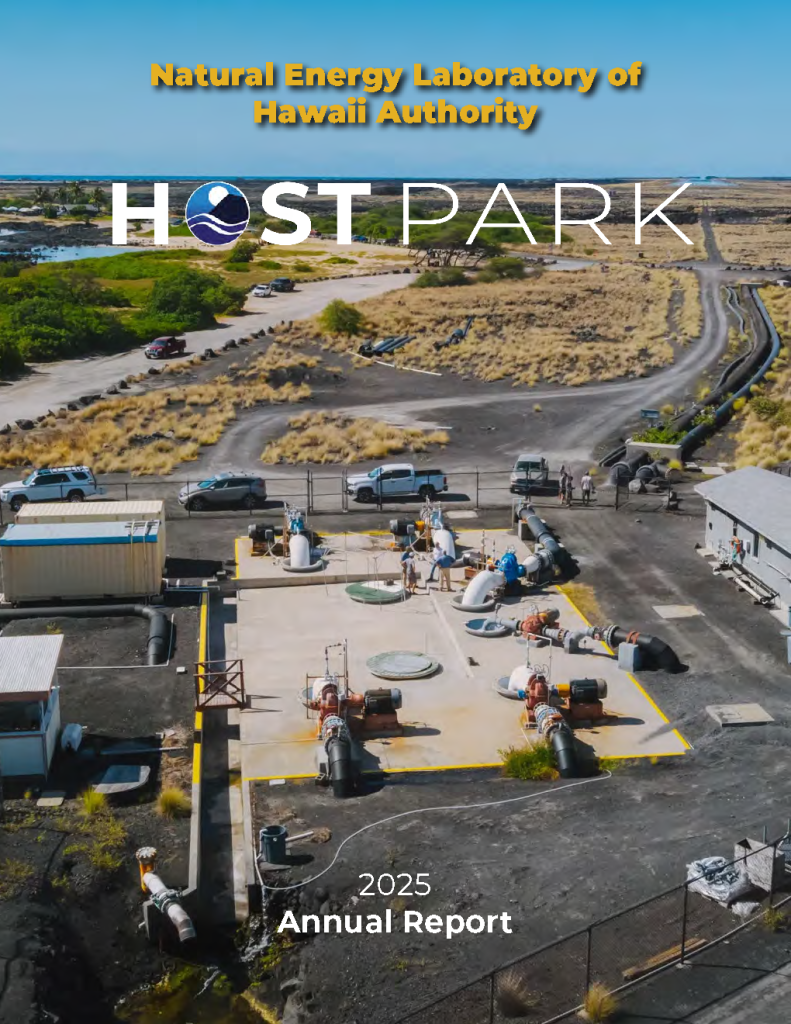
Annual Report for 2025 (ADA compliance)
Highlights:
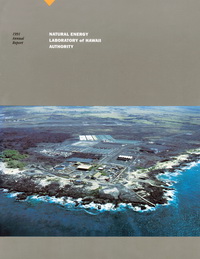
- Completed underwater offshore survey for sources of freshwater, report pending.
- Developed 10-year deferred maintenance program.
- Implemented quarterly Talk Story program.
- Initiated onshore EIS.
- Completed 4-year federally-funded aquaculture incubator project.
- Expanded new hostpark.io website and online tour to include cultural and historical research.
- Creation of a plan to manage Ho’ona Preserve.
|
 |
| 2024 |
27.8 |
Annual Report for 2024 (ADA compliance)
Highlights:
- Advanced plans for seawater air conditioning (SWAC) in West Hawai‘i.
- Progressed hydrogen fueling and storage projects at the Research Campus.
- Expanded aquaculture operations by Blue Ocean Mariculture; Cyanotech sustained global nutraceutical markets.
- New marine biotechnology and food innovation ventures entered HOST Park.
- Battery demonstration projects continued in collaboration with national and international partners.
- Infrastructure investments supported the long-term growth of HOST Park tenants.
- Friends of NELHA hosted record visitor numbers and expanded STEAM education programs.
- HOST Park tenants contributed substantially to the local economy through revenues and job creation.
|
 |
| 2023 |
46.7MB |
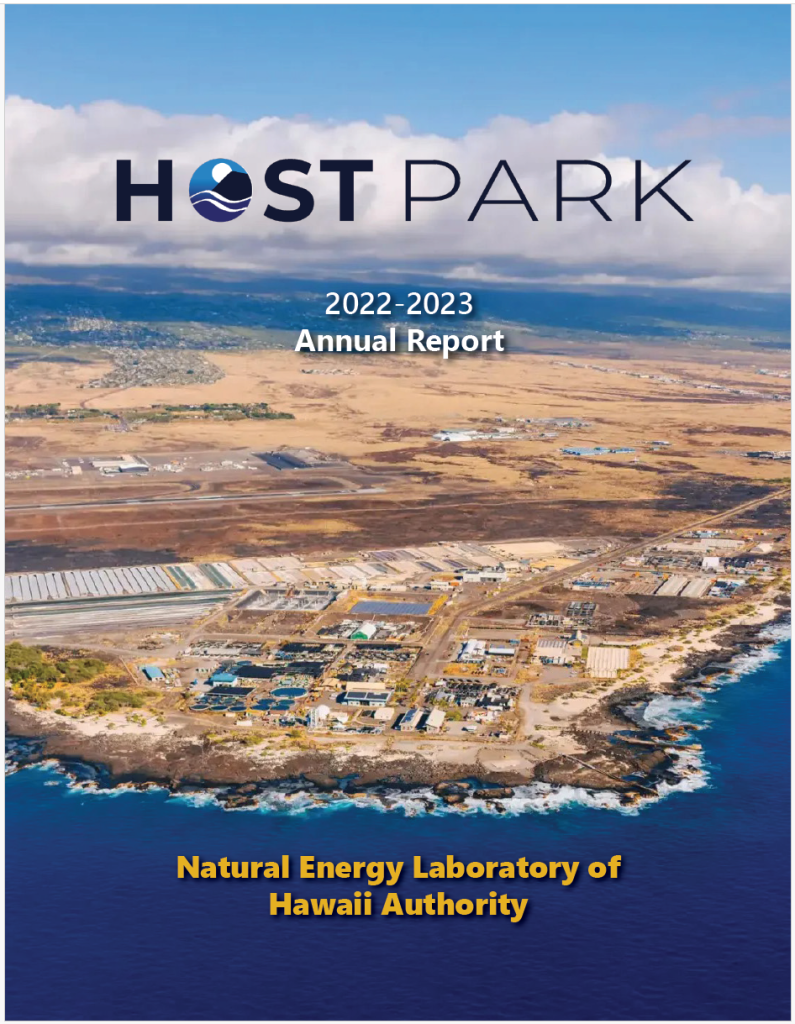
Biennial Report for 2022 and 2023.
Highlights:
- Blue Ocean Mariculture expanded offshore kampachi production and opened a new processing facility.
- Cyanotech increased exports of Spirulina and Astaxanthin products to international markets.
- Hawai‘i Oceanic Institute and partners advanced marine biotechnology initiatives.
- HATCH accelerator hosted international aquaculture startups, with strong investor engagement.
- Hydrogen fueling and storage station moved forward at Research Campus.
- Microgrid and energy storage testbed projects advanced with DOE and national lab partners.
- Continued progress on seawater air conditioning feasibility for West Hawai‘i.
- Battery and desalination pilot projects launched with federal and international collaborators.
- Friends of NELHA resumed in-person tours and expanded STEAM educational programs, reaching thousands of visitors.
- HOST Park tenants contributed tens of millions annually to the local economy, supporting hundreds of jobs.
|
 |
| 2023 |
.6MB |
Biennial Report for 2022 and 2023 – ADA Version. |
 |
| 2021 |
12.4MB |
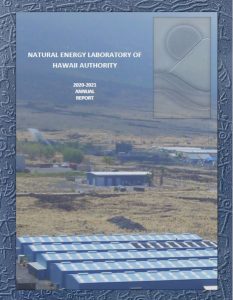
Biennial Report for 2020 and 2021.
Highlights:
- Aquaculture tenants expanded operations: Blue Ocean Mariculture scaled production of kampachi; Big Island Abalone and Cyanotech maintained strong markets.
- HATCH Blue aquaculture accelerator hosted global startups; follow-on investment funds expanded.
- Continued development of the hydrogen fueling and storage station at the Research Campus.
- Energy initiatives advanced: seawater air conditioning (SWAC) feasibility study, vanadium redox flow battery testing, and microgrid planning.
- Installed additional solar PV at Research Campus, improving energy self-sufficiency.
- New tenant projects advanced in marine biotechnology and food production.
- Friends of NELHA adapted tours and educational programs during pandemic restrictions; outreach reached global audiences through hybrid/online offerings.
- NELHA revenues remained near $5M annually, sustaining operational independence.
|
 |
| 2020 |
|
Included in 2021 report. |
|
| 2019 |
30.1MB |
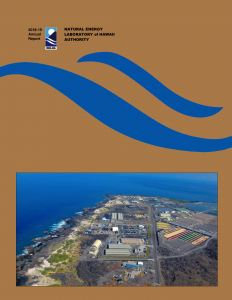
Biennial Report for 2018 and 2019.
Highlights:
- Completed Kaiminani Drive and related road projects ahead of schedule and under budget, officially opening a new entrance to HOST Park.
- Progressed $2.5M potable water well, including archaeological surveys, recovery plan, and environmental assessment; FONSI published in 2018.
- Secured FEMA approval for $7.6M to address the destruction of the Puna Geothermal property during the 2018 eruption.
- Leasing remained steady with new clients; Mats4 LLC and Kowa Premium Foods projects advanced.
- Aquaculture initiative launched: statewide summit in 2017, $500K State funding secured, and 2019 accelerator partnership with HATCH Blue and UH Ventures established; $8M follow-on fund created.
- Energy initiatives included $1.9M U.S. DOE grant for Trevi Systems’ solar thermal desalination plant (world’s largest FO desalination demo).
- Vanadium redox flow battery project advanced with Sandia National Lab, UET, HELCO, and Ulupono.
- Energy Storage Conference (2018) brought DOE, national labs, and private partners together.
- Installed 178kW PV at Research Campus, saving ~$50K annually.
- Selected for the Korea KETEP grant to explore HOST Park microgrid demonstration.
- Continued development of hydrogen production, storage, and fueling station.
- Initiated feasibility study for seawater district cooling system for West Hawaiʻi with $250K in CIP funds.
- Friends of NELHA hosted ~8,000 visitors annually, expanded education and outreach, and received $175K State grant-in-aid.
- NELHA designated a Blue Zone (HOST Ola) in 2018, emphasizing health and wellness.
- Revenues held steady near $5M annually; NELHA remained operationally self-sufficient.
|
 |
| 2018 |
|
Included in 2019 report. |
|
| 2017 |
31.5MB |
Highlights:
- Groundbreaking for $10M road construction project to open Ocean Center Piece parcel; fast-tracked to finish ahead of schedule.
- Planning advanced for an exploratory potable water well to add 333,000 gallons/day capacity; verbal commitment secured from the County of Hawai‘i for water credits.
- Leasing hit record levels: 21 new agreements, 7 new tenants, including Hale Iako occupancy reaching ~70%.
- Mats4 LLC approved for concept lease of a sustainable convenience store and fuel station at HOST Park entrance.
- Energy Storage Systems Conference (Sept 2016) hosted 110 attendees, including DOE and national lab leaders; multiple projects emerged.
- Vanadium redox flow battery project launched with DOE, Sandia, HELCO, and Ulupono Initiative; installation planned for FY2018.
- Hydrogen production, storage, and fueling station project began construction at the Research Campus.
- RFP planned for new 100–300 kW OTEC plant to advance commercialization.
- Hawai‘i aquaculture initiative launched with HSDC; planning for Hawai‘i Center for Aquaculture Sustainability (HCAS).
- Renovations continued at Research Campus, including upgrades to Hale Kaa.
- Friends of NELHA hosted ~6,300 visitors at the Hawai‘i Gateway Energy Center, expanded STEAM programs, and increased tour offerings.
- NELHA revenues remained above $5M, with seawater sales and land use fees sustaining self-sufficiency.
|
 |
| 2016 |
15.91 MB |
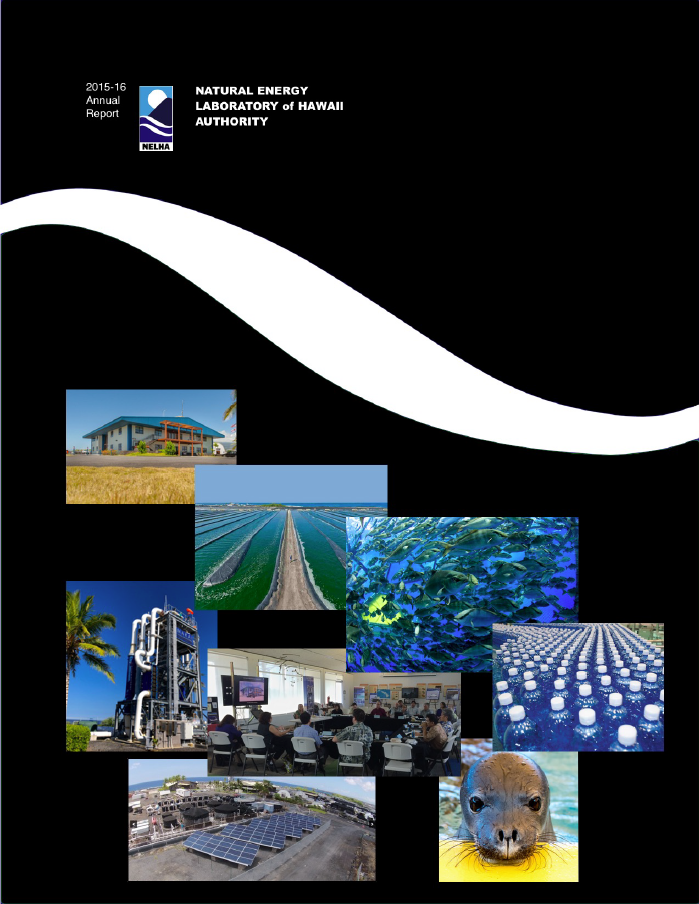
Biennial Report for 2015 and 2016.
Highlights:
- Hale Iako incubator and office building completed (14,000 sf, $5M investment, 60% leased at opening).
- 28-inch surface seawater connector pipeline completed ahead of schedule and 50% under budget.
- Aquaculture boom: Hawai‘i SPF shrimp supplied up to 60% of global broodstock; Blue Ocean Mariculture expanded offshore Kona Kampachi farm.
- Kampachi Farms partnered with Lockheed Martin for “Forever Oceans” open-ocean aquaculture project.
- Makai Ocean Engineering launched 100 kW OTEC plant—the world’s largest operational and only U.S. grid-connected OTEC facility.
- Energy storage testbed launched; Aquion Energy M100 battery installed; expanded partnerships with Sandia, NREL, and UH.
- Hydrogen production and fueling station project advanced with UH and DOE partners.
- NELHA received U.S. President’s “E” Award for Export Service (2016).
- HOST Park economic impact: $123M annually, 617 jobs supported.
- Leasing activity surged: 15 new agreements in FY2015 and FY2016.
- Website visits and Twitter engagement grew steadily; Friends of NELHA hosted ~5,000 visitors annually.
- Staff milestones: Greg Barbour completed 30 years of service with the State of Hawaii; Hale Iako renovations highlighted NELHA’s evolution into a “small college campus” atmosphere.
|
 |
| 2015 |
|
Included in 2016 report. |
|
| 2014 |
3.09 MB |
Highlights:
- NELHA celebrated 40 years since its founding in 1974.
- Nearly $12M in state and federal capital improvement funds for pipelines, pump stations, and roads.
- Design completed for clean energy and biotech incubator; construction launched with $3M EDA grant + $1M state funds.
- DOE/NREL solar energy testbed completed at Research Campus (35 kW).
- Strategic partnerships built with Sandia, PNNL, NREL, and LBNL; positioned HOST Park as a test site for energy storage.
- Pipeline infrastructure: major repair of 40” deep seawater line extended system life by 15–20 years; awarded DBEDT “Team of the Year.”
- UHERO study found HOST Park generated $123M in economic output, $5M in state taxes, and 617 jobs.
- Construction activity surged: $60M in new private investment since 2012, including Shrimp Improvement Systems expansion.
- Lease activity: 9 new agreements, 4 new tenants, 14 potential projects in review.
- Friends of NELHA hosted ~5,000 visitors; NELHA’s website logged nearly 50,000 page views.
- Hosted Ironman World Championship aid stations and community engagement.
- The environmental monitoring program marked 25 years of continuous data collection, confirming stable and pristine conditions.
- Staff updates: Dr. Alex Leonard joined as Administrative & Projects Manager; Dean Towle as Operations Engineer; longtime staff member Karin Haleamau retired.
|
|
| 2013 |
3.24 MB |
Highlights:
- Shrimp Improvement Systems moved world HQ to HOST Park; invested $10M and employed ~40 people.
- 14 construction projects underway or planned, totaling $51.5M in public and private investment.
- Marine Mammal Center (Monk Seal Hospital, Phase I) broke ground ($3.2M private).
- Cyanotech expanded with new office and extraction facilities ($4.5M private).
- Taylor Shellfish expanded ponds and facilities ($1M private).
- West Hawaii Explorations Academy began $8.5M new charter school project.
- NELHA pipeline repairs advanced on the 40” system ($5.3M state-funded).
- Destiny Deep Seawater/Encon installed $2M preform manufacturing equipment.
- $412K NREL grant supported SCADA system and photovoltaic testbed.
- Planned projects included SIS Phase II ($4M), Makai OTEC turbine ($4M ONR), Kahilihili Road ($9.7M), SSW connector pipe ($2.3M), and $4M+ in building renovations.
- Negotiations advanced with OTEC International for 1 MW demonstration facility.
- Friends of NELHA tours grew from 2,327 visitors (2011) to 4,938 (2013).
- Analytical Laboratory completed 32nd year of continuous EPA-certified monitoring.
- Lease activity included 8 new agreements, 1 new tenant, and 28 potential projects under review.
- CEROS program officially closed out in October 2012.
- State allocated $12M for connector road linking HOST Park to Kaiminani/Queen Ka‘ahumanu Highway.
- NELHA operated its 4th year without state subsidy.
|
|
| 2012 |
8.25 MB |
Highlights:
- Updated Master, Strategic, and Marketing Plans.
- Secured $3.0M in federal funds to renovate the main administration building into an incubator for alternative energy and biotechnology.
- Secured $400,000 in federal funds for initial development of a research campus micro-grid.
- Independent UHERO Economic Impact Study found HOST Park generated $87.7M and 583 jobs statewide in 2010.
- Cyanotech featured as leading HOST Park business; ended the year with $27M in revenue.
- Makai Ocean Engineering opened the OTEC heat exchanger test facility; NELHA entered negotiations with OTEC International for 1 MW demonstration facility.
- Received $412K U.S. DOE/NREL grant to develop distributed energy systems and a solar test bed.
- Pipeline and road infrastructure upgrades planned, including $5.3M in repairs to 40” deep seawater pipeline.
- Analytical Laboratory maintained EPA-certified standards and completed 31 years of continuous environmental monitoring.
- Master lease extended through 2066; seven new agreements signed and 20 new projects under review.
- CEROS program concluded under DARPA–NELHA cooperative agreement.
- NELHA hosted international conferences and expanded marketing and media outreach.
|
|
| 2011 |
0.67 MB |
Biennial Report for 2010 and 2011.
|
 |
| 2010 |
|
Included in 2011 report. |
|
| 2009 |
0.58 MB |
Highlights:
- Supported 43 tenants with only 16 staff, maintaining 24/7 seawater reliability.
- Act 157 authorized NELHA to produce and distribute renewable energy onsite and to neighbors.
- Continental Airlines flew on biofuel partially derived from algae grown at Cyanotech.
- Cellana ramped up prototype commercial modules for algae biofuels.
- Makai Ocean Engineering launched OTEC heat exchanger research at the 40” and 55” pipelines.
- An international research team isolated dissolved organic matter from NELHA waters, advancing climate studies.
- NoriTech gained approval to import nori after nearly two years of effort.
- BioEnergy Hawai‘i proposed $100–150M waste-to-energy and algae biofuel project, pending lease resolution.
- Completed earthquake repairs on 18” and 40” pipelines.
- CEROS distributed $9.89M for 18 contracts in ocean technology.
|
 |
| 2008 |
0.30 MB |
Highlights:
- Weathered the 2008 global economic downturn while maintaining operations.
- Continued development of renewable energy projects, including solar thermal and algae-based biofuels.
- OTEC planning advanced with partners exploring pilot-scale demonstrations.
- Deep seawater bottling industry contracted after rapid early growth, prompting tighter market focus.
- Kampachi, shrimp, and abalone aquaculture operations strengthened commercial production.
- Hosted multiple international delegations studying HOST Park’s seawater systems and aquaculture models.
- CEROS distributed $4.3M in federal funding to 12 defense-related ocean technology projects.
- Capital improvements advanced, including potable water distribution upgrades and seawater system expansion.
- NELHA Board refined financial and policy frameworks to guide tenant growth during volatile markets.
|
 |
| 2007 |
1.04 MB |
Highlights:
- Reached self-sufficiency: no general funds used; operations covered by tenant revenues.
- Secured $365,000 annual state subsidy to offset high electricity costs for aquaculture tenants.
- October 2006 earthquakes damaged deep seawater pipelines; emergency repairs restored supply.
- Issued RFPs for 5 MW photovoltaic array and 1 MW OTEC plant—major public/private energy projects.
- Recruited four major energy tenants: Cellana (algae biofuels), Keahole Solar Power (solar thermal), Hawaii Natural Energy Institute (hydrogen), Hawaii EODC (solar concentrator).
- Lease rates restructured for the first time in NELHA history; seawater pricing adjusted for sustainability.
- $1.3M released for capital improvements, including airport connector road planning, pipeline expansion, and potable water system upgrades.
- $5.25M appropriated for 55” pipeline pumping and distribution expansion.
- Two new aquaculture tenants leased 15 acres (names not specified in the report).
- Water Quality Lab reorganized; first manager hired in four years.
- CEROS funded 17 defense-related ocean technology projects with $5.5M in federal support.
|
 |
| 2006 |
0.15 MB |
Highlights:
- First year of no General Fund support; NELHA moved toward full self-reliance.
- Seawater rates increased 20% annually until full cost recovery; new lease policies raised extractive rates to $3,000/acre-month.
- Operating loss reduced to $47,000 before accounting for a $500,000 A/C system replacement; total loss $552,000.
- Legislature appropriated over $1.5M for capital projects: master plan update, airport connector road, seawater system upgrades, freshwater valve installation, and groundwater monitoring wells.
- Foreign Trade Zone status granted in September 2006, broadening tenant opportunities.
- International delegations from Taiwan, Korea, Morocco, and others visited to explore deep seawater bottling and standards.
- NREL grant supported continued studies on distributed energy grids.
- Agreement signed with Ocean Engineering & Energy Systems to construct world’s first commercial OTEC plant at NELHA.
- Sopogy proposed a 10 MW solar thermal project; HR Petroleum advanced algae-derived biodiesel; HNEI began hydrogen fuel research at the Gateway Center.
- CEROS received $6.9M in DoD appropriations; Richard Hess became Technical Director.
- Earthquakes on October 15, 2006 caused only minor seawater interruptions; operations were restored within hours.
|
 |
| 2005 |
1.05 MB |
Highlights:
- Operation of 55-inch, 3,000-foot deep seawater pipeline began, delivering 14,000 gallons per minute, the deepest in the world.
- Koyo USA expanded production to nearly 1 million bottles per day; opened Mahalo Showroom in Waikīkī.
- Deep Seawater International (Kona Deep) opened its first bottling facility in July 2005.
- Hawai‘i Deep Marine and Enzamin USA transitioned to commercial production.
- Standardized royalties and certification program established for “Hawaiian deep sea water”; foreign imitators forced to stop.
- Big Island Abalone became the largest abalone exporter to Japan and a global leader outside China.
- Kona Bay Marine Resources earned the Governor’s Exporter of the Year Award (2004); expanded shrimp broodstock operations.
- Cyanotech sustained over $12 million in annual revenues; expanded international distribution.
- Friends of NELHA expanded docent program; prepared to staff Gateway Energy Center.
- West Hawai‘i Explorations Academy won the Intel-Science School of Distinction in Science Award.
- Energy research reemerged: DOE and New Mexico Tech explored OTEC, hydrogen, solar, and microgrid projects.
- NELHA implemented new seawater rate structures to align with rising energy costs.
- CEROS has funded over $70 million in maritime and defense-related projects since its inception, supporting 120+ jobs.
|
 |
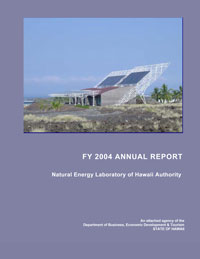
| 2004 |
0.30 MB |
Highlights:
- 38 active tenants supported 238 jobs.
- Over $15 million invested in capital improvements.
- Aquaculture gross sales reached $19.5 million (70% of state production).
- Koyo USA launched deep seawater bottling for export; Enzamin USA and Hawaiʻi Deep Marine entered the market.
- Trademarked logo and royalty program created for seawater exports.
- Big Island Abalone and Kona Bay Marine Resources received Governor’s Exporter of the Year awards; Koyo USA was recognized as Exporter of Manufactured Products.
- Legislature began phasing out state funding; NELHA cut costs and introduced new rents and royalties.
- Hawaiʻi Gateway Energy Center’s main building and first lab module neared completion.
- HGEC incorporated zero-net energy design, seawater cooling, solar chimney, and native landscaping.
|
 |
| 2003 |
8.83 MB |
Highlights:
- Dedication of NELHA’s Distributed Energy Resources (DER) Center held on August 22 with Senator Daniel K. Inouye, Governor Linda Lingle, and federal, state, and local officials.
- Completion of NELHA Gateway Visitor Center first phase; planning advanced for exhibits and public education programs.
- OTEC demonstration project revived with new studies on closed-cycle systems.
- Research on deep ocean water uses has expanded, including aquaculture, agriculture, and functional foods.
- Tenants generated over $25 million in annual revenues, supporting 200+ jobs.
- Cyanotech introduced new astaxanthin product BioAstin® to global markets.
- Big Island Abalone Corporation harvested 100 tons of abalone annually, serving domestic and international customers.
- Moana Technologies completed facilities for the shrimp genetics program.
- Friends of NELHA expanded education tours, reaching 5,000+ visitors in the year.
- Federal and state funding secured for additional Gateway facilities and energy research.
|
 |
| 2002 |
|
Highlights:
• Completion of 55-inch deep seawater pipeline; received 2002 Hawaiʻi Section Outstanding Civil Engineering Achievement Award.
• Moana Technologies began shrimp broodstock genetics facility.
• Cyanotech launched Japanese business unit in Tokyo.
• Big Island Abalone Corporation opened 10-acre farm, then the largest abalone production facility outside China.
• SyAqua Research LLC introduced shrimp genomics research.
• Unlimited Halibut Corporation proposed halibut and sablefish operations.
• Small Business Compound completed.
• Planning advanced for Gateway Project; Senator Daniel K. Inouye secured federal funding.
• Groundbreaking scheduled for Distributed Energy Resources Center.
• Reliance on State General Funds reduced to 40%.
|
 |
| 2001 |
1.29 MB |
Biennial report for 2000-2001.
Highlights:
2000
- Dedication of Big Island Abalone Corporation held May 16 with Governor Cayetano and local officials.
2001
- 55-inch deep seawater pipeline entered final stage of development; shipments en route to Hawaiʻi with completion expected FY02.
- Gateway Project planning is advanced, including the Ocean Center Commercial Area for renewable energy, marine biotechnology, and ocean sciences.
- Tenant revenues surpassed $15 million annually, supporting 176 private-sector jobs and creating a total economic impact of $30–40 million per year.
- Cyanotech expanded to over 90 acres; annual revenues exceeded $15 million from Spirulina-based products marketed in more than 30 countries.
- Aquasearch introduced AstaFactor™, earning “Biotechnology Company of the Year” from the Hawaiʻi Technology Association.
- Friends of NELHA was formalized as a nonprofit to support education, tours, and outreach.
- Board restructured with new standing committees: Commercial Activities chaired by Peter Young, Strategic Development chaired by Bill Friedl, Audit chaired by Barry Mizuno, and Research Advisory chaired by Don Thomas, Ph.D.
- Legislature expanded the Board from 9 to 11 members, adding representatives from HTDC and HSDC to encourage cross-agency collaboration.
|
 |
| 2000 |
|
Included in 2001 report. |
|
| 1999 |
7.83 MB |
Biennial report for 1998-1999.
Highlights:
- Designed and built a new Booster Pump Station to support HOST Park seawater supply.
- Hawaii Legislature allocated $16 million in CIP funds for the expansion of the seawater system, boosting capacity by 40,500 gpm surface and 28,500 gpm deep seawater.
- Over 160 Project Initiation Packets were distributed to prospective tenants; the Board heard more than a dozen proposals.
- New tenants: Marine BioProducts (seaweed research), Ocean Rider (seahorse culture), Stockly’s Aquariums (anchialine shrimp).
- EagleNet Sea Farms and Oceanic Institute approved to break ground at HOST Park.
- Woods Hole’s “Café Thorium” and Marine Life Investigative Group joined as research tenants.
- Aquasearch completed $2.5M facility; launched astaxanthin production with Finnish partner Cultor Ltd.; joined UH’s MarBEC.
- Big Island Abalone Corporation tripled its facility; secured a 10-acre HOST Park site for commercialization.
- Black Pearls, Inc. developed hatchery tech and mobile quarantine systems; advanced the state’s ocean leasing law.
- Coast Seafoods expanded the oyster and clam seed nursery at Keahole.
- Common Heritage Corp. launched an integrated “blue-green revolution” deep seawater demo system.
- Cyanotech expanded to 183 acres; launched BioAstin™; partnered with Norsk Hydro ASA; named Governor’s Exporter of the Year.
- High Health Aquaculture expanded SPF shrimp broodstock program.
- Indo-Pacific Sea Farms advanced coral and clam culture research.
- Kona Bay Oyster & Shrimp Co. marketed blue shrimp to local hotels.
- Kona Cold Lobsters distributed live Maine lobster and Dungeness crab across Hawaiʻi and Asia.
- MacFarms tested a proprietary irrigation system at NELHA.
- Makai Ocean Engineering continued OTEC research with CEROS support.
- Marine BioProducts, Inc., advanced specialty agar production research.
- Ocean Rider developed seahorse breeding for ornamental and herbal markets.
- Ono Take Inc. transitioned shiitake and reishi mushroom research to commercial production.
- Pacific Harvest doubled its moi growout facilities, expanded overseas markets.
- PICHTR concluded 210 kW open-cycle OTEC demo project, dismantling plant in 1999.
|
 |
| 1998 |
|
Included in 1999 report. |
|
| 1997 |
6.56 MB |
Highlights:
- Tenant count increased by 8%; leased acreage grew 30%; tenant employment rose 30% to 174.
- Tenant revenues totaled $13.6 million; overall economic impact exceeded $43 million.
- Nine new business starts and multiple tenant expansions advanced HOST Park’s growth.
- The legislature passed bills permitting retail/tour facilities and expanding NELHA’s purpose to include ocean-related research and technology.
- CEROS relocated to NELHA; funded 16 projects at $5.5M with an additional $6.4M for FY98.
- Big Island Abalone Corp. launched a pilot project to develop Hawaiʻi’s first commercial abalone farm.
- Aquasearch expanded photobioreactor patents, partnered with C. Brewer, and planned large-scale astaxanthin production.
- Black Pearls Inc. advanced hatchery tech for pearl oysters and established a Marshall Islands farm using remote quarantine methods.
- Coast Seafoods began construction of one of the world’s largest oyster and clam seed nurseries at Keahole.
- Common Heritage Corp. developed deep ocean water–based “blue-green revolution” systems for agriculture and freshwater, with dedication set for 1998.
- West Hawaiʻi Explorations Academy expanded enrollment by 40% to 80 students, continuing its integration of education and research onsite.
|
 |
| 1996 |
8.01 MB |
Highlights:
- Severe state budget cuts reduced NELHA staff by one-third, but the Authority continued to expand operations.
- Three new tenants gained final approval; six more received preliminary approval; four existing tenants optioned additional land for expansion.
- CEROS (National Defense Center of Excellence for Research in Ocean Sciences) was transferred under NELHA, bringing its administrative offices to Keāhole.
- West Hawaiʻi Sea Grant Extension Office and UH Small Business Development Center established operations on-site, providing new resources for tenants.
- Product sales from NELHA-based companies exceeded $13 million; approximately 130 people were employed.
- Continued operation of PICHTR’s 210kW open-cycle OTEC plant, the only one of its kind in the world.
- Major improvements to seawater systems, including replacing failing ductile iron manifolds with HDPE, and extending the 28” pipeline by 760 ft.
- Automation of surface seawater systems at the Kau Pump Station reduced energy waste and improved efficiency.
- Laboratory building refurbished with new roof, AC repairs, and cosmetic upgrades.
- Two parallel 66-inch tunnels completed via pioneering micro-tunneling for future HOST Park seawater pipelines.
- Submersible dives with PISCES V surveyed routes and inspected existing pipelines.
- Cyanotech, Aquasearch, Taylor United, and Common Heritage Corp. all optioned new land for expansion; Cyanotech exercised options and expanded operations.
- “Information superhighway” brought internet connectivity and marketing expanded to global audiences through video, conferences, and digital outreach.
|
 |
| 1995 |
4.76 MB |
Highlights:
- Four new tenants joined; other tenants expanded, grossing over $5M in sales and employing more than 100 people.
- International delegations from Okinawa and the Philippines sought NELHA’s expertise to replicate cold seawater technologies.
- Strategic Planning Committee (SPC) confirmed NELHA’s mission was succeeding, noting tenants’ $25M in capital investments and $13M in annual sales, for a $75M total economic impact.
- SPC recommended state capital improvement funding to help NELHA reach self-reliance.
- CEROS transitioned under NELHA’s oversight, with land set aside for expansion into 548 undeveloped acres.
- First phase of 55-inch seawater pipeline system advanced despite engineering delays; tunneling extended beneath the shoreline, with full system planned to reach 3,000 ft.
- NOVA Group began constructing two 66-inch tunnels via pioneering microtunneling, a milestone in environmentally sensitive infrastructure.
- Submersible dives are scheduled with PISCES V to survey routes and inspect nine deep pipelines.
- Improvements made to seawater and freshwater systems, new discharge wells, and the rehabilitation of ponds supported incoming tenants.
- Operations staff upgraded pumping systems, reducing electricity costs and improving efficiency.
- Grounds, labs, and visitor facilities received aesthetic and practical improvements, including new seawater demonstration fountains.
- Comprehensive Environmental Monitoring Program (CEMP) completed its full year; services extended to tenants and external agencies.
- Administration produced a Program Effectiveness Evaluation Report and executed eight new leases and agreements.
- “Colloid Cookoff” brought 21 scientists from 11 institutions to conduct groundbreaking research on ocean colloids.
- Robert Kihune was named DBEDT Manager of the Year for his leadership during NELHA’s downsizing and strategic planning.
|
 |
| 1994 |
3.96MB |
Highlights:
- 20th anniversary celebrated, with strategic planning and organizational restructuring to emphasize quality and tenant support.
- New leadership: Robert K. U. Kihune became Executive Director, succeeding Clare Hachmuth.
- HOST Park seawater expansion: Construction began on twin 55-inch shoreline pipes, the critical first step toward deep seawater delivery for HOST Park.
- Operations: Continuous 24/7 delivery of seawater and utilities; assisted in modifications to the NPPE OTEC plant and installed major upgrades including new pumps and cross-connections.
- Engineering: Completed the Hale He‘ena Laboratory building, nominated for “Engineering Project of the Year”; initiated micro-tunneling project to bring pipelines under the shoreline.
- Analytical Lab: Completed full year of CEMP monitoring, supported multiple tenants, and contributed to projects in Hawaiʻi and the Cook Islands.
- Administration: Published updated Strategic Plan and Facilities Use Manual, executed new leases and permits.
- Marketing & Outreach: Hosted over 3,000 visitors, staged an Open House, and represented NELHA at major international conferences in Japan, the U.S., Canada, and the U.K.
|
 |
| 1993 |
4.88 MB |
|
 |
| 1992 |
3.12 MB |
|
 |
| 1991 |
7.41 MB |
|
 |
| 1990 |
3.00 MB |
Biennial report for 1988-1990.
Highlights:
- Sea Grant publishes “OTEC Aquaculture in Hawaii” in November 1988.
- Cyanotech is fully developed on 15 acres with 16 raceways for microalgae. In 1988 they begin developing astaxanthin with BASF.
- RHSF adds ʻele ʻele to their commercial algae business and expands to two acres, distributing more than a ton of product a week.
- Uwajima Fisheries/Yonezawa Suisan build out their one-acre site for hirame flounder production.
- Alstroemeria flowers are added to the strawberries and lettuces grown within the NELH compound using cold seawater condensate.
- EPRI provides funding for an HNEI project in early 1989 that investigates the possibility of using algae to remove carbon dioxide from fossil fuel exhaust gases.
- ALCAN begins testing roll-bonded aluminum elements for heat exchangers at NELH in January 1989.
- HMTSTA Phase II experiments develop data that are incorporated into the design of the Net Power Producing Experiment planned for construction at NELH.
- The Hawaii County Economic Opportunity Council designs and constructs an experimental solar desalination system in Milolii.
- OFC pipeline deployments are completed in this FY with a total of six 6,000-ft. pipelines, and three more 4-acre ponds are constructed.
- At OTEC, Alcan closed-cycle materials testing announces a breakthrough in the reduction of heat exchanger costs.
- Closed-cycle OTEC analysis shows that most aluminum alloys do not develop pitting in warm surface seawater, but significant pitting appears in most alloys tested in deep coldwater.
- The 3-megawatt HGP-A power plant at the NELH Puna facility is shut down and the geothermal well temporarily closed in December 1989. The sale of the power plant will provide funds for refurbishment of the site and remaining buildings.
- DOE funding is discontinued in December 1989.
- Projects funded under CGNP were in various stages of development when the HGP-A well operation was terminated in December 1989.
- NELH significantly expands water quality lab staff, facilities, and instrumentation during 1989 and 1990.
- NELH merges with HOST Park to create NELHA. The newly created Natural Energy Laboratory of Hawaii Authority, with a new Board and Chairman, is established on July 1, 1990. Dr. John Craven is recognized for his service.
- This is the last report of the Natural Energy Laboratory of Hawaii as an independent entity of the State of Hawaii. NELH merges with HOST Park to create NELHA.
- Notable clients to date have been the Federal Sea Grant Program, the Department of Energy, the Solar Energy Research Institute, Argonne National Laboratories, the General Electric Corporation of Great Britain, the Aluminum Company of Canada, and the University of Hawaii at Manoa.
- Eighteen new projects are approved: fifteen at Keahole Point and three at the Puna Research Center.
- Sixty-three acres of land at NELH are committed to specific tenants.
- Four more seawater pipelines are deployed to Ocean Farms of Hawaii.
- The Kona site now employs 143 people, and there are 44 acres developed by the private sector.
- NELH Honolulu office closes and transfers all administration to Kona in April of 1990.
- A Cooperative Environmental Monitoring Program (CEMP) for the Keahole area is initiated in 1990.
- Savings from the cold seawater air conditioning system now provide an average savings of $400 a month.
- Sogi International receives approval for a research program on ethanol from cane sugar molasses using solar stills cooled with cold seawater for distillation.
- YORK Air Conditioning develops an idea for a freon recycling system using a solar boiler and cold seawater.
- Dewani Lauro Marine Products receives final approval of their edible seaweeds commercial facility at NELH in March 1990 and begins construction.
- D/S Ventures tests the possibility of culturing edible sea cucumbers (namako).
- Sea Farms of Hawaii grows tilapia with oysters in a prototype tank.
- Hawaii Seafood Growers begins test marketing of mahi mahi grown at NELH.
- Hawaii Cultured Pearls begins research project using mixtures of seawater.
- Microbio Resources tests Dunaliella haematococcus microalgae growth in culture ponds at NELH, starting in June 1990.
- The ʻOpihi Project concludes.
|
 |
| 1989 |
|
Included in 1990 report. |
|
| 1988 |
4.30 MB |
Highlights:
- To honor two men active in the development of deep ocean resources in Hawaii whose lives were lost to the power of the sea, pipeline dedication ceremonies were held at NELH-Kona on June 3, 1988, for Patrick Wolter of American Divers and Henry Horn of Makai Ocean Engineering.
- Realignment of the 12-inch pipeline was completed in August 1987.
- Air conditioning of the laboratory using cold seawater as coolant is installed in late summer 1987, saving a net average of $350 a month.
- Proposal by NELH and ADP for the development of an informal visitor center and tours is approved by the NELH Board in July 1987.
- Fiscal Year 1988 is considered to be the year that NELH comes of age, as five new pipelines capable of delivering 23,000 gallons per minute of deep ocean water were installed and became operational. Complete redundancy of seawater supplies is achieved at Keahole Point.
- DOE/HOST/PICHTR 40” pipeline and pump station, installed by Kewitt Pacific, begins full-time operation on June 23, 1988.
- Research is being carried out by DOE, SERI, ANL, and PICHTR.
- Expansion of OTEC agriculture project to one-acre experimental farm is authorized.
- Hawaiian Abalone Farm becomes Ocean Farms of Hawaii, installs two 16” pipelines to its 16-million-gallon kelp pond, and is expanding to grow oysters, sea urchins, and salmon.
- Royal Hawaiian Sea Farms adds ogo, expands to a 1-acre site outside of the NELH compound.
- Cyanotech increases pond acreage to 9 acres for microalgae cultivation.
- A merger of NELH and HOST Park will be proposed to the 1989 Legislature.
- Media interest sees an uptick.
- The visitor program hosts 3,500 people in FY1988 and will be expanded.
- Puna Geothermal considers a nearby geothermal mini-park to provide land for commercialization of projects that emerge from research.
- The Puna HGP-A geothermal plant receives a major overhaul funded by the 1987 State Legislature, increasing power generation to 2.2 MW.
- During FY1988, eight research projects are conducted at PGRC.
- NELH-Kona employs 80 people, of whom 65 are with the private sector projects.
- HOST Park underground electrical supply extended to NELH, replacing the temporary feed from Keahole Airport.
- Plans are made to expand the analytical capabilities of the NELH water quality laboratory.
- A Cooperative Environmental Monitoring Program (CEMP) begins development for HOST Park and NELH.
- A 7-acre expansion of the NELH compound is under construction using State CIP funds.
- OTEC Heat Transfer, Biofouling, and Corrosion projects draw to a close per DOE instructions at the six-year point. Warm water loops closed in May and June, final coldwater loops shut off in September of the previous year.
- Data collection begins in late summer 1987 from the OTEC Heat and Mass Transfer Scoping Test Apparatus (HMTSTA). Two 36-ft. towers were erected in July 1987.
- First potable freshwater produced from open-cycle OTEC experiment on August 21, 1987.
- Second OTEC condenser tower erected in June 1988.
- ASTM Corrosion Tests conducted in spring of 1988.
- Johns Hopkins Phytoplankton Project wraps up in September 1987.
- Kona Seacoast Facility experiments with solar fish-drying units.
- Aquaculture Enterprises (AE) begins new project in FY1988 at NELH to produce Maine lobster using cold deep seawater.
- A Japanese-based firm proposes a flounder-growing project. The project begins on July 1, 1988.
- NELH requests State funds to expand the Honolulu office to meet dramatically increased need.
|
 |
| 1987 |
|
Not available. |
|
| 1986 |
3.52 MB |
Highlights:
- State Legislature appropriates $1,000,000 for the design and implementation of an emergency backup pipeline at NELH
- HAF sells abalone to local restaurants
- Cyanotech now producing and shipping spirulina and beta carotene, and is constructing 10 new ponds to utilize their 15-acre lease
- Ongoing OTEC agriculture project adds asparagus and lettuce irrigated with coldwater pipe condensate
- February 1986: a period of large waves separates the pipe in the nearshore zone, highlighting the need for a redesign of the nearshore routing and anchoring
- NELH water quality lab completes major renovation and expansion
- NELH begins active management of HPG and the Puna Geothermal Research Center
- HTDC begins development of HOST Park on state land adjacent to NELH. Groundbreaking held November 1986
- Capital investment in NELH now totals $16 million, in nearly equal thirds from state, federal, and private sources
- Onsite employment now totals 45, of which 35 are private sector generated
- NELH houses 19 projects in FY86, 33 projects total. The Puna NELH facility houses 7 projects
- Coldwater experiments have been run for 1,521 days
- Designs are complete for an upgrade of the NELH emergency electrical system
- Using DOE funds, a design to provide air conditioning to the NELH laboratory building by using a heat exchanger connected into the existing chilled water system is proposed
- At OTEC, continued experimentation in FY1986 further confirms the efficacy of intermittently-applied low chlorine levels for effective biofouling control
- At year’s end, plans are nearing completion for a major new OTEC experimental apparatus using larger tanks and more sophisticated instrumentation
- 2,800 people take part in the visitor program
- In June 1986, the county receives $600,000 in State Capital Improvement Funds for expansion of the Puna Geothermal Research Center
- Preparation begins on a report that will summarize the results of coldwater aquaculture research at NELH
- An important experiment conducted in April 1986 clarifies the nature of the variability of various water quality parameters measured in NELH’s weekly water sampling program
- Office of Naval Research investigates the variability and dynamics of phytoplankton with help from Johns Hopkins University and NELH
- UHM Dept. of Agricultural Engineering investigates the efficacy of a trench seawater return system for NELH and HOST Park
|
 |
| 1985 |
3.52 MB |
Highlights:
- Arrangements completed for new experiment at NELH to be conducted by ALCAN International, which will install large test heat exchangers in both warm and coldwater streams. Biofouling and corrosion data will be connected automatically and transmitted by modem to ALCAN labs in London, England
- Current plans call for construction of major new Open Cycle Test Facility at NELH
- NELH assumes management responsibility for the Puna Geothermal Facility, provides onsite manager. Jan War becomes Operations Manager
- HTDC plans development of Hawaii Ocean Science and Technology (HOST) Park on 547 acres of state land adjacent to NELH. Park will provide sites where successful NELH research projects can move to commercial development. Initial plans include pipeline installations, grading, roads, electricity, fresh water. An additional 24” cold water pipe is planned
- July: Cyanotech Microalgae Facility dedication. First commercial harvest of spirulina happens in August
- Data analysis manager added to staff. Core staff is now at 10.5 positions
- As of June 1985, coldwater experiments have run for 1,158 days. Two new large capacity pumps are delivered and expected to bring the coldwater system up to 1,300 gpm
- HAF begins assembling a mile-long PVC 15” pipe to be deployed down to 2,000 ft. in depth
- Plans completed for a renovation of NELH water quality laboratory. Construction contract is awarded in August
- Information kiosk at the highway entrance is completed. Three sign panels completed. Visitor information program has expanded and includes presentations to community groups and schools
- HAF excavates four 4-acre kelp ponds, begins pipeline construction
- Cyanotech builds four large oval raceways with large paddle wheels for water circulation. Process building is constructed
- Closed-cycle OTEC project adds independent system of three additional loops for a SERI-sponsored study of non-chemical biofouling control: one loop uses ultraviolet light, one uses ultrasonic control, and one serves as a control on the other two
- Warm seawater flows through 12 experimental loops throughout FY85
- Mist Lift experiments lose funding
- Dr. Murray Daily of CSU Long Beach begins project in cooperation with Waikiki Aquarium to investigate feasibility of culturing giant clams in Hawaii. 2,000 specimens from Palau brought to raceways built at NELH in August
- Initial experiments on proposed development of commercial-scale nori production facility at NELH conducted in August
- American Sea Ranch oyster project terminated in June 1985
- Strawberry experiment is considered successful, but is paused
- PICHTR prepares a proposal to build and operate open-cycle demo plant at NELH
- Village Marine Technology approaches NELH about testing desalination systems at the lab
- West Coast Lobster Company proposes a lobster growout and hatchery operation on land leased from NELH
|
 |
| 1984 |
4.12 MB |
Highlights:
- 21.3-acre abalone farm groundbreaking (Hawaiian Abalone Farms). Hawaii governor and Hawaii County Mayor attend
- Proposed projects include strawberry growing using cold condensate on the seawater pipes, as well as aquaculture production of oysters, clams, marine shrimp, spirulina, and other marine algae
- Plans formulated for installation of a 30-inch coldwater pipe to supplement the 12-inch system
- Act No. 59 amends the NELH enabling legislation to include “commercialization” as a stated goal
- Formal ground lease for NELH is approved by BLNR
- User fees from aquaculture budgets begin to contribute to the operation budget
- A PR Officer is hired part-time to support tours, lectures, and brochures/information packets, bringing staff up to 9.5 positions
- Cold water experiments have run for 732 days
- An information kiosk to be built at the highway entrance to NELH is planned and funded
- Dr. Ralph Berger produces spectacular electron micrographs of biofouling organisms
- New facility for the study of corrosion and macrofouling under slow-flow conditions is constructed
- Phase III of the One-third Scale Coldwater Pipe at Sea Test Program is conducted
- UC Berkeley Marine Sciences Group is funded to study environmental impacts of the installation and use of proposed facilities
- HIMB scientists continue research on the growth of salmon and rainbow trout in deep coldwater. Manipulation of temperature and photoperiod induce steelhead trout to spawn in seawater
- NELH contracts with Analytical Services of UHM to produce computerized database and summary reports of three-year data set of water quality parameters
- Cyanotech negotiates for a 4-acre parcel to grow spirulina in pure saltwater
- Instrumentation studies conducted off NELH aid in the design of the Deep Underwater Muon and Neutrino Detection Project
- Jack P. Huizingh becomes first permanent executive director of NELH in October
|
 |
| 1983 |
2.58 MB |
Highlights:
- Core staff grows to nine
- NELH the only facility in the world supplying a continuous flow of cold, deep seawater, and through 6,000 feet of pipe. Cold water experiments have run for 337 days
- Warm water intake pipe begins providing cleaner water, which helps delay biofouling
- NELH installs a protective system for the onshore pipes: half-round corrugated metal pipe mounted on a concrete base protects and covers 400 ft. of pipe from the lighthouse to the sea cliff. Extensions planned down to the seafloor in FY84
- Proprietary abalone culture experiments expand with a 50,000-gallon tank containing kelp, and growout tanks are added
- By June of 1983, NELH operations include: Warm seawater supply, Cold seawater supply, Water chemistry laboratory, Tech support, a growing list of facilities, a computer for online heat transfer data processing, six various vehicles, a private VHF system, and environmental monitoring
- OTEC biofouling and corrosion research expands and is supplemented by research into open-cycle processes
- Discharged coldwater continues to support aquaculture research, including salmon and rainbow trout aquaculture, nori (macroalgae) farming, Maine lobster aquaculture, and abalone culture
- Fiscal Year 1983 sees the initiation of regular weekly water sampling and analysis for both incoming warm and cold water and the effluent discharge
- A new project sponsored by DOE monitors the corrosion of candidate materials proposed for jacketing interisland deep sea power transmission cables
- Solar insolation measurements continue and NELH remains an official National Weather Service observation station
- The Alcoa Corrosion Project begins, measuring corrosion of proprietary alloys
- Design of a one-acre salt-solar pond 30KW power generating system for NELH is completed
- Opihi/Hawaiian limpet culture experiments begin
|
 |
| 1982 |
2.21 MB |
Highlights:
- Seacoast Test Facility federal funding interrupted, but biofouling and corrosion studies continue
- February: Hawaii Natural Energy Institute sponsors workshop for discussing potential uses of the laboratory facilities
- A Laboratory Director is appointed
- One mile long, 12” polyethylene cold water pipe is assembled at Kawaihae Harbor and floated to Keahole, where it is deployed in two sections
- Cold seawater supply system is installed and by February pumps 340 gallons per minute of seawater from a depth of 2,000 ft. into the lab
- Rapid initiation of biofouling of the warm water surface seawater supply system triggers design of a 300 ft. extension to the warm water intake
- Ten 600-gallon fiberglass tanks are built for a potential salmon and rainbow trout aquaculture project. Another ten tanks are built to investigate the feasibility of growing edible seaweeds
- Seven 1,000-gallon tanks are installed to investigate the effects of chlorine levels on the marine food chain
- Facilities now include indoor and outdoor lab space, a shop and warehouse support, office space, an offshore research corridor, and a 24’ workboat
- Chlorination appears to control biofouling completely in all candidate materials
- Initial testing begins on a program to grow mollusks
- Sanders Associates contact NELH about a project to grow Maine lobsters, erect a 20” by 50” inflatable hatching and growout building
- Hurricane Iwa causes brief project interruptions in November, after large waves inundate the NELH facility, knock down the perimeter fence, and submerge all instruments on the Test Pad. Pipes remain intact. Facility repairs take weeks
- U.S. Navy deep diving submersible dives three times off Keahole Point, including down to a depth of 1,925 ft., to video and photograph the pipe system and the mini-OTEC CWP left in the research corridor since 1980
- NOAA grant funds three dives in October with the submersible Makaliʻi from HURL to take video and photographs of the equipment as well as charting the slope
- Ongoing projects include Solar Insolation data gathering, atmospheric corrosion data gathering, the DOE/Simplex Cable Corrosion Project, and pipe outfall effects analysis
|
 |
| 1981 |
15.5 MB |
Highlights:
- Seacoast Test Facility federal funding interrupted, but biofouling and corrosion studies continue
- February: Hawaii Natural Energy Institute sponsors workshop for discussing potential uses of the laboratory facilities
- A Laboratory Director is appointed
- One mile long, 12” polyethylene cold water pipe is assembled at Kawaihae Harbor and floated to Keahole, where it is deployed in two sections
- Cold seawater supply system is installed and by February pumps 340 gallons per minute of seawater from a depth of 2,000 ft. into the lab
- Rapid initiation of biofouling of the warm water surface seawater supply system triggers design of a 300 ft. extension to the warm water intake
- Ten 600-gallon fiberglass tanks are built for a potential salmon and rainbow trout aquaculture project. Another ten tanks are built to investigate the feasibility of growing edible seaweeds
- Seven 1,000-gallon tanks are installed to investigate the effects of chlorine levels on the marine food chain
- Facilities now include indoor and outdoor lab space, a shop and warehouse support, office space, an offshore research corridor, and a 24’ workboat
- Chlorination appears to control biofouling completely in all candidate materials
- Initial testing begins on a program to grow mollusks
- Sanders Associates contact NELH about a project to grow Maine lobsters, erect a 20” by 50” inflatable hatching and growout building
- Hurricane Iwa causes brief project interruptions in November, after large waves inundate the NELH facility, knock down the perimeter fence, and submerge all instruments on the Test Pad. Pipes remain intact. Facility repairs take weeks
- U.S. Navy deep diving submersible dives three times off Keahole Point, including down to a depth of 1,925 ft., to video and photograph the pipe system and the mini-OTEC CWP left in the research corridor since 1980
- NOAA grant funds three dives in October with the submersible Makaliʻi from HURL to take video and photographs of the equipment as well as charting the slope
- Ongoing projects include Solar Insolation data gathering, atmospheric corrosion data gathering, the DOE/Simplex Cable Corrosion Project, and pipe outfall effects analysis
|
 |
| 1980 |
3.70 MB |
Cumulative report for 1978-1980
Highlights:
- NELH formalizes legal status and obtains necessary permits and rezoning to develop a research center. A Master Developmental Plan is drawn up and submitted
- RCUH proposal for funding OTEC test facility accepted by US Department of Energy
- Seacoast Test Facility project founded on five acres near Keahole Point
- Groundbreaking at NELH site at Keahole Point on January 12, 1979
- Mini-OTEC project begins, generates net energy
- Access road construction, site improvement, and utility expansion, including a fresh water supply line, are completed December 1979
- NELH incorporated as a nonprofit corporation in 1980
- By 1980, multiple projects and site studies are underway, including bathymetry surveys, land surveys, phytoplankton monitoring, and bottom current surveys
|
 |
| 1979 |
|
Included in 1980 report. |
|
| 1978 |
|
Included in 1980 report. |
|
| 1977 |
3.06 MB |
Cumulative report for 1974-1977.
Highlights:
- January: EA and Phase I Master Plan for NELH accepted; capital improvement funds of $750,000 requested from the State
- April: Improvement funds of $750,000 approved by the State Legislature
- NELH-related proposed studies begin flourishing
- November: Establishment of Ocean Research and Baseline Data Collection Area, 1,000 ft. wide and extending one mile seaward
- December: EIS approved
- Interim facilities at the site include a diesel-generating plant, a small office, and a project monitoring lab
- The state authorizes $750,000 for a surfaced access road from the highway, a water supply line, interim sewage disposal facilities, and a 300 kV electric power supply line, to be followed by phone and data service, an enclosed service support area, and a graded test area
- In the summer, the State of Hawaii funds a bathymetry study. Precise depth records are run from seaward of the U.S. Coast Guard lighthouse to a depth of about 3,000 feet
- NELH-related ocean studies continue to expand and include the Environmental Survey of the Benthic Ecosystem, the OTEC Mariculture/Algal Project, DOE/ERDA multiple Biofouling and Corrosion contracts, and a Site Selection Bathymetry Survey required for submersible dives to 370 meters to collect visual observations and photographic recordings of the bottom conditions and biota
|
 |
| 1976 |
|
Not available. |
|
| 1975 |
1.74 MB |
Highlights:
- OTEC (Ocean Thermal Energy Conversion) test facility proposal submitted
- January: RCUH chosen to provide corporate structure and financial/management functions
- February: Six-person Board of Directors appointed, representing State, County, and University of Hawaiʻi interests
- April: Three-person staff appointed by the Board of Directors
- April: Preliminary discussions of an OTEC project
- May: Meetings with ERDA (Energy Research and Development Administration) indicate ERDA is responsive to proposals
- June: Board of Directors authorizes the Scientific Director to coordinate efforts among a growing list of interested parties
- July: OTEC proposal to ERDA is drafted. Total first-year budget request is $7,842,400
- December: Permits requested for NELH to locate small diesel-electric generators at Keahole Point and a temporary power cable across the shoreline
|
 |
| 1974 |
3.86 MB |
Initial NELH report.
Highlights:
- 1967: Direct flights begin from the West Coast to Hilo
- 1971: State completes construction of the first phase of the interisland airport at Keahole Point
- 1972: State Legislature passes Act 236, SLH 1974, establishing the Natural Energy Laboratory of Hawaiʻi (NELH). Establishment date: June 14. Planning funds are matched dollar-for-dollar by the County of Hawaiʻi
- Site of NELH chosen for nearby cold, deep ocean water and warm surface layer not subject to strong seasonal cooling, high annual solar radiation, accessibility to airports, harbors, and highways, and large tracts of undeveloped land. All these factors occur together only at Keahole Point, and the land is owned by the State of Hawaiʻi
- Manager: Marine Affairs Coordinator for the State of Hawaiʻi
- July 1974: $100,000 in planning funds released by State and County
- 1974: Kona has 3,000 hotel units and 6,000 residents
|
 |